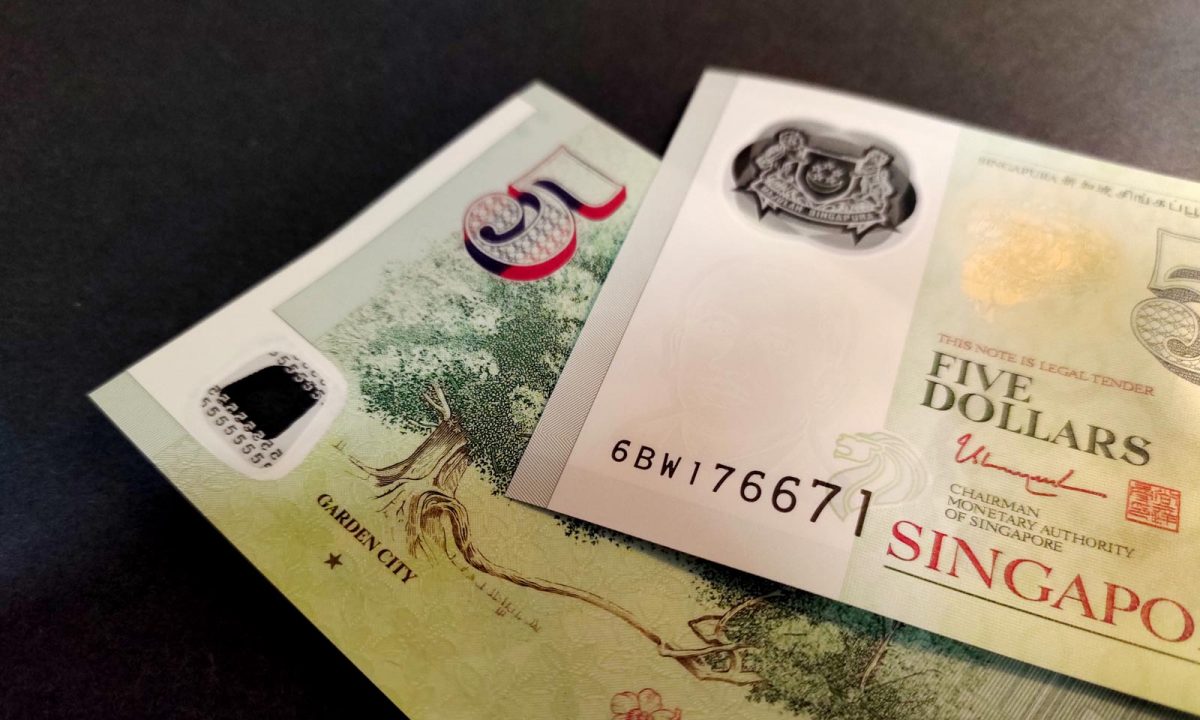
There is a new symbol for the Singapore $5 Portrait Series polymer banknote: one star. These circulation banknotes have serial numbers starting with the digit ‘6’, and are first observed during the banknote exchange period prior to Hari Raya Puasa in May 2020.
This is perhaps the first time a new batch of banknotes was released during the Hari Raya Puasa banknote exchange period. Typically, more new prefixes and symbols have been observed during the Chinese New Year banknote exchange period at the start of the calendar year, during which the $5 denomination has not been as popular as the $2, $10 and $50 denominations.
Based on previous batches of banknotes starting with the digits ‘4’ and ‘5’, the $5 denomination has an uncut sheet size of 45 pieces per sheet. The first prefix is believed to be 6AA, while the last prefix is believed to be 6BW.
Singapore $5 Portrait Series Banknote Symbols
As of May 2020, there are five different symbols for the Singapore $5 Portrait Series notes:
A new symbol of three hollow stars has been observed on the Singapore $2 Portrait Series circulation banknote. These banknotes have serial numbers starting with the digit ‘6’, which have various ‘star’ symbols featured on the reverse side.
If you have information about the prefixes for the three hollow stars symbol, please let us know.
Since 2016, six different ‘star’ symbols have been observed on the $2 polymer notes. As of January 2020, the symbols are one star, two stars, three stars, one hollow star, two hollow stars and three hollow stars.
In early 2019, limited pieces of $2 notes with a house symbol on the reverse have been observed in circulation. These banknotes bear serial numbers starting with the digit ‘7’. This could have meant that prefix ‘6’ would finally come to an end, but it seems that more prefixes are still being released during the banknote exchange period ahead of the 2020 Chinese New Year.
Singapore $2 Portrait Series Banknote Symbols
There are currently 13 different symbols for the Singapore $2 Portrait Series notes:
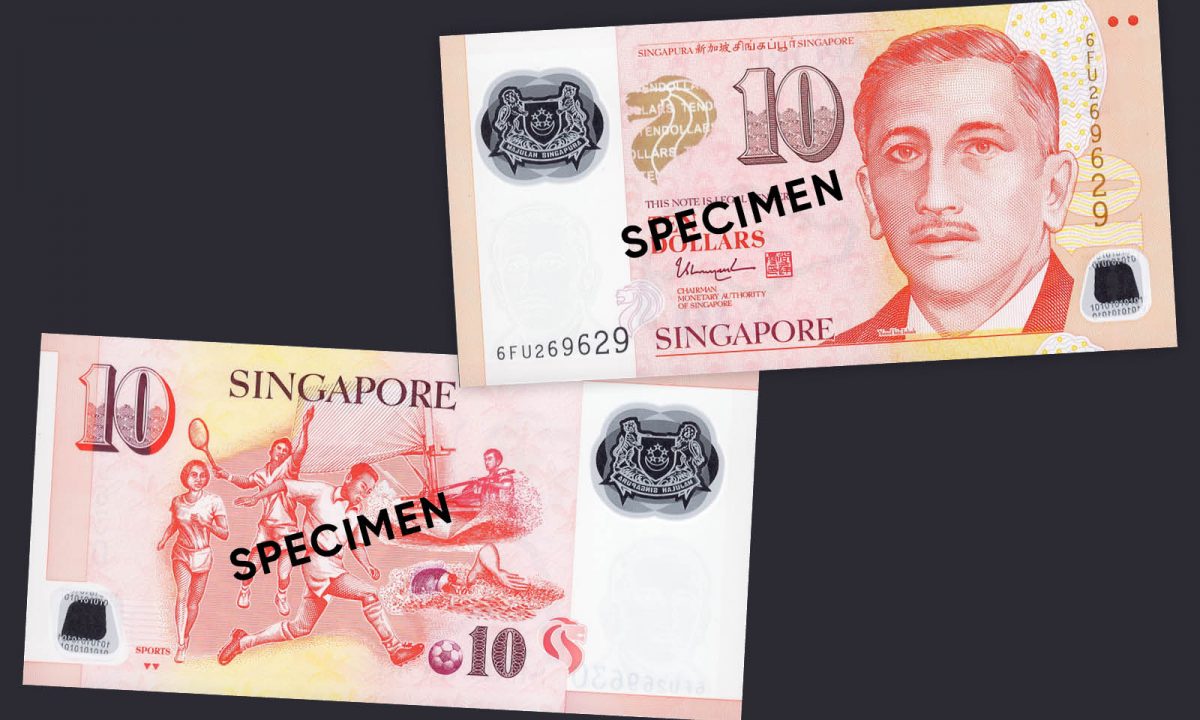
Two inverted triangles have been observed on the Singapore $10 Portrait Series banknote in January 2020. The polymer banknote features the symbol on its reverse side, below the word ‘Sports’ on the bottom left corner of the note.
The banknotes have serial numbers starting with the digit ‘6’, similar to those featuring a single inverted triangle on the reverse side. These circulation notes bear the signature of Mr Tharman Shanmugaratnam, Chairman of the Monetary Authority of Singapore (MAS).
To date, the $10 note has seen 13 different symbols:
In early 2019, a small number of $2 banknotes with one house below the word ‘Education’ (on the reverse side) started to surface. The serial number of these Portrait Series banknotes start with the digit ‘7’, which may mean that serial numbers starting with the digit ‘6’ will finally come to an end.
This comes after a total of 362 prefixes (beginning with the digit ‘6’) and five symbols worth of banknotes were put into circulation since 2016. The symbols were one star, two stars, three stars, one hollow star and two hollow stars.
In 2016, the first prefixes beginning with ‘6’ were 6NA to 6QJ (one hollow star). This was followed by 6AA to 6CM (one star) and 6QK to 6SV (two hollow stars) in 2017.
In 2018, prefixes 6CN to 6HM (two stars) were introduced, alongside 6AA to 6CM (two stars). A limited number of 6FA 51xxxx to 6HM 51xxxx (three stars) were also observed in early 2018. At some point during the same year, prefixes 6SW to 6TB (two hollow stars) were also observed.
The remaining serial numbers for 6FA to 6HM (three stars) were released in 2019, together with new prefixes 6HN to 6KZ (three stars).
New symbols on the reverse of the banknotes are typically observed at the start of the year, around two to three weeks before Chinese New Year.
Among the various denominations of Singapore banknotes, the $2 banknote is one of the most widely and frequently circulated. Perhaps this is the reason why the $2 denomination is the first to get a prefix starting with the digit ‘7’.
As of November 2019, very few pieces of $2 banknotes with one house have been observed. But it is just a matter of time before these notes are eventually put into circulation, so remember to keep a lookout for them.
One House Symbol on $10 Notes
The house symbol is not entirely new, as it has previously appeared on the $10 note with prefixes 5EA to 5FW (one house), 5FX to 5HT (two houses). Hollow house symbols have also been observed on the $10 denomination: 5NA to 5QH (one hollow house), 5QJ to 5SU (two hollow houses). That was the first time for a hollow symbol to appear. The latest symbol on the $10 note is one inverted triangle, with serial numbers starting with ‘6’.
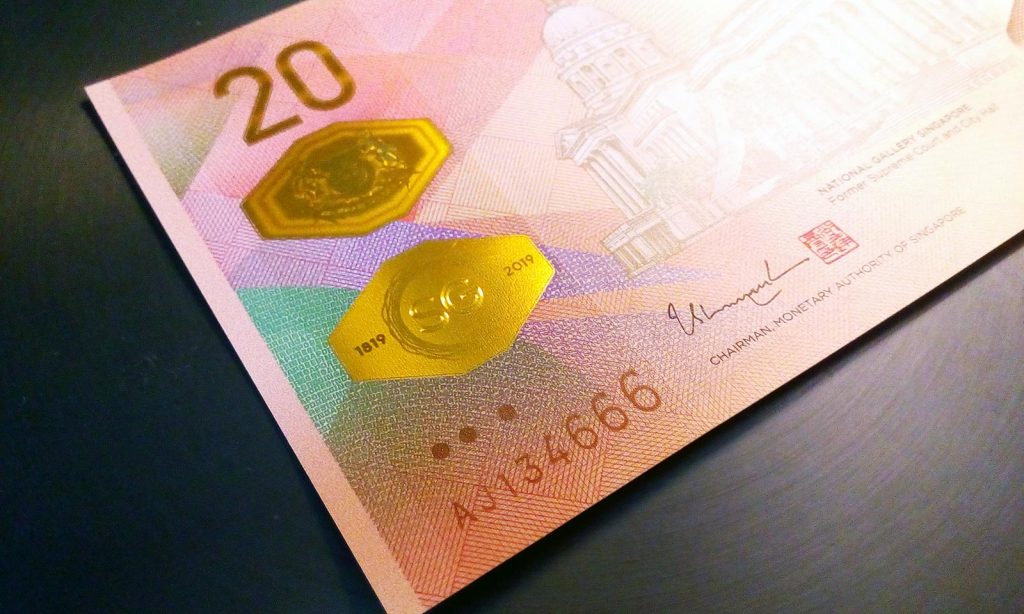
Last Prefix for Singapore Bicentennial $20 Note: AJ
The initial batch of $20 Singapore Bicentennial banknotes also came with four different prefixes: AB, AC, AD and AE.
Banknotes found on the uncut sheet of 3 bear the AA prefix, with serial numbers ranging from AA 801xxx to AA 832xxx. A total of 5000 such uncut sheets were produced.
No Symbol on Reverse
Banknotes from the second printing do not come with any special symbol printed on the reverse. Since 2009, MAS has used symbols to indicate the printing batch for the Portrait Series, as well as the SG50 commemorative issue.
The symbols include squares, triangles, diamonds, stars, houses and inverted triangles – either single, double or triple. Symbols can also have a solid colour, or appear as a hollow outline.
Limited Demand for Limited Edition?
According to a press release by MAS, applicants for the second batch were allocated the full number of banknotes which they have asked for. There were more than 200,000 applications for around 1.8 million banknotes. In other words, around 0.2 million banknotes from the second print run have not been allocated yet.
MAS has previously mentioned that notes which are left over after 18 November 2019 will be made available to the public for exchange. So keep a look out if you’ve missed your chance during the online application phase, or if you want to get hold of more.
Related Questions
How many Singapore Bicentennial $20 notes are there? MAS issued a total of 4 million banknotes in two separate batches. Initially, 2 million banknotes were put into circulation in June 2019. This was followed by another 2 million in November 2019 to meet popular demand.
What is the first prefix for the Singapore Bicentennial $20 notes? For the first batch of 2 million circulation banknotes, AB is considered as the first prefix. AF is unofficially the first prefix for the second batch.
What is the last prefix for the Singapore Bicentennial $20 notes? Strictly speaking, AJ is the last prefix for the Singapore Bicentennial commemorative banknotes. Since AE used to be the last prefix before the additional print run, it can still be considered as the last prefix for the first print run of 2 million notes.
The Monetary Authority of Singapore (MAS) will be making another 2 million pieces of Singapore Bicentennial $20 notes available. Exchange can be made from 4 to 18 November 2019.
This additional batch of 2 million banknotes is printed to meet the popular demand during the original release on 10 June 2019. Back then, stocks at banks were depleted quickly within two to three days of issue.
This time, Singapore citizens and permanent residents can apply for up to 10 pieces of commemorative notes using their identification number and mobile number. Application can be made through an online portal launched by MAS which runs for four weeks until 13 October 2019.
The results of the application will be made by 3 November. Exchange can be made at the preferred bank branch that was selected during online application during a two-week period.
If there are any notes left over at the end of the exchange period, members of the public can exchange these notes without the need for any online application.
Allocation priority will be given to applicants who belong to the Pioneer Generation and Merdeka Generation – those born on or before 31 December 1959. But if demand is too high, MAS would be adjusting the number of notes allocated to individuals accordingly.
Applicants who have been successfully allocated the commemorative notes can get another person to exchange the notes on their behalf by providing a copy of their NRIC or birth certificate.
Prefixes and Serial Numbers
Update: As of 4 November 2019, four new prefixes AF, AG, AH and AJ were observed.
For the first batch of $20 Singapore Bicentennial notes, there are four circulation prefixes: AB, AC, AD and AE. Serial numbers as high as 83xxxx have been observed.
With up to 840,000 serial numbers for each of the four prefixes (or 3.36 million in total) there may be new prefixes observed for the second batch of Singapore Bicentennial notes. Similar to recent polymer banknote issues, serial numbers may be skipped during production, and there are no replacement serial numbers.
For the 3-in-1 uncut sheets, banknotes have serial numbers ranging from AA 801xxx to 832xxx. Larger uncut sheets of up to 32 may be made available in a future auction.
Symbol on Reverse?
Update: The second batch of $20 commemorative notes appear to be the same as the banknotes from the initial printing. There is no special symbol found on the reverse.
The only circulation banknote from the Portrait Series which does not have the symbol is the discontinued $10000 note. Since the original issue on 9 September 1999, there was no subsequent reprint for the $10000 banknote.
For the SG50 commemorative notes issued in 2015, three different symbols were observed: one diamond and two diamonds for the $10 notes, and one star for the $50 note.
The $10 notes with two diamonds on the reverse have been printed on auctioned notes with special serial numbers, as well as a limited number of circulation notes for 3 of the 5 designs.
There was no symbol printed on the 2017 issue which commemorated 40 years of Currency Interchangeability Agreement (CIA40) between Singapore and Brunei Darussalam.
Online Application for Singapore Bicentennial $20 Notes
Application can be made through the MAS online portal.
Related Questions
What prefixes are used for the second print run? AF, AG, AH and AJ have been observed to date. However, some banks have been issuing banknotes from earlier prefixes (i.e. AB to AE) during the November collection period.
How can I tell if a banknote was from the additional print run? The prefixes for the serial number from the second print run are AF, AG, AH and AJ. If your banknote has these prefixes, then it’s from the additional 2 million pieces printed. Apart from this, banknotes from both batches appear to be the same.
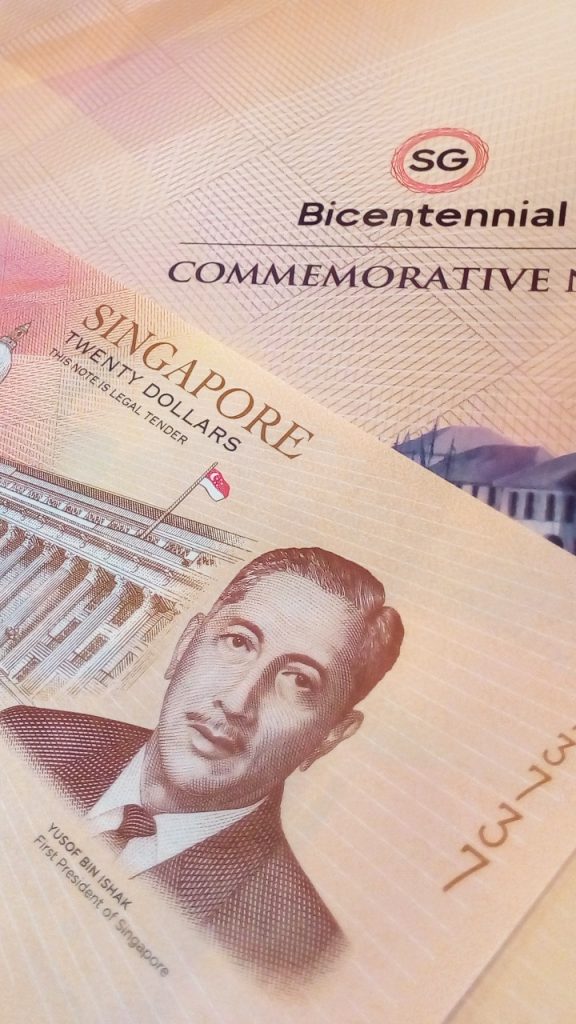
On 10 June 2019, the Monetary Authority of Singapore (MAS) issued a single commemorative note as part of the Singapore Bicentennial celebrations. Instead of a $200 note, the MAS opted for a $20 denomination in order to make it more affordable for Singaporeans to own a piece of history.
This $20 polymer banknote commemorates 200 years since the landing of Sir Stamford Raffles on the shores of Singapore in 1819. In total, 2 million banknotes were put into circulation. Members of the public could exchange these commemorative banknotes at the face value of $20 each. There was a limit of 20 pieces per transaction, and notes were made available at major bank branches across Singapore.
Compared to the previous commemorative issue in 2017 to mark 50 years of Currency Interchangeability between Singapore and Brunei Darussalam, stocks were depleted quickly for the Singapore Bicentennial notes. In 2017, 2 million commemorative banknotes were issued by MAS, with a face value of $50 each. There was another 1 million $50 banknotes issued by the Monetary Authority of Brunei Darussalam. These banknotes were still made available at banks right before the 2019 Chinese New Year festive period.
Each note also comes with a commemorative folder that has a two-sided transparent window which can be used to display the banknote. Unlike the hard cover folders for the SG50 commemorative banknotes (2015) and the 50th Anniversary of Currency Interchangeability Agreement notes (2017), the folder for the Singapore Bicentennial banknotes comes with a matte-finished soft cover.
The inside of the folder contains a short description of the bicentennial commemorative banknotes, as well as a message by Prime Minister Lee Hsien Loong. The message was written in the four official languages of Singapore: Malay, Mandarin, Tamil and English.
The banknote was launched by President Halimah Yacob at the Istana’s Hari Raya Puasa open house held on 5 June 2019. The note was designed by local artist Eng Siak Loy, together with his son Weng Ziyan. This was also the third time a $20 note appeared in the history of Singapore currency: the first two being the $20 Bird Series circulation note (1979) and the $20 commemorative note to celebrate 40 years of Currency Interchangeability Agreement between Singapore and Brunei Darussalam (2007).
For more information on previous banknote issues, you may wish to get hold a copy of my book, Singapore Banknote: Complete Prefix Reference. Detailed descriptions are provided for all commemorative banknotes in Singapore’s currency history.
The front of the note shows a portrait of Singapore’s first president, Yusof bin Ishak. It also shows the former Supreme Court and City Hall, which is currently occupied by the National Gallery Singapore. The left side of the note also features the numerals ‘20’, the Singapore Coat of Arms, the Singapore Bicentennial logo and the years ‘1819’ and ‘2019’, all printed in gold foil with optically variable effects. The banknote carries the signature of MAS Chairman Tharman Shanmugaratnam.
The reverse side pays tribute to eight pioneers who have contributed to Singapore in the early days in various ways. These individuals arrived on the shores of Singapore from as early as the 1800s, helping to lay the foundations for Singapore.
The back also shows the Singapore River, flowing from the past to the present. The Singapore River helped Singapore transform herself into a trading port in the early days, and eventually into a thriving financial centre for the region.
Unlike the SG50 commemorative banknotes issued in 2015, there are no special symbols found on the back of the note to indicate the batch.
There are five prefixes for this commemorative banknote: AA, AB, AC, AD and AE. Prefix AA is used for the 3-in-1 uncut sheets. On the first day of issue, all four remaining prefixes AB, AC, AD and AE have been observed on single notes.
These banknotes are legal tender in Singapore, and can be used in day-to-day transactions. Perhaps you may be lucky enough to receive these banknotes as change when you go shopping next time?
Update: On 14 June 2019, the MAS announced in a media release that there will be another additional 2 million pieces of Singapore Bicentennial $20 note. The second batch of commemorative notes is expected to be issued around October to November. The first batch of 2 million notes were fully exchanged at the banks within a week.
Similar to all other commemorative issues, the Singapore Bicentennial banknote cannot be deposited into cash deposit machines. Due to the limited quantity of banknotes issued, and that most of these notes will be kept for future generations, it is not too cost-effective for banks to calibrate their machines to accept these notes.
The Singapore Bicentennial commemorative note also comes as a 3-in-1 uncut sheet, with an issue date of 20 June 2019. A total of 5000 uncut sheets were issued by balloting. These uncut sheets are distributed by the Singapore Mint, and comes in an acrylic display case.
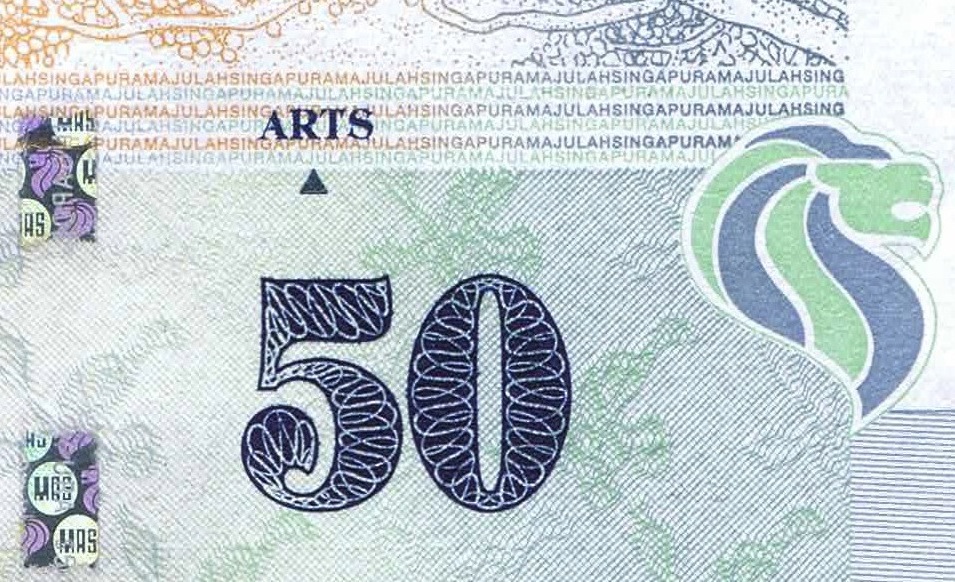
Singapore $50 note with three stars on the reverse
In January 2019, the Singapore $50 banknote with three stars below the word ‘Arts’ has been observed in circulation. The banknote bears the signature of MAS Chairman Tharman Shanmugaratnam.
Similar to the $50 banknotes with one and two stars, the serial number of the banknote starts with the digit ‘5’.
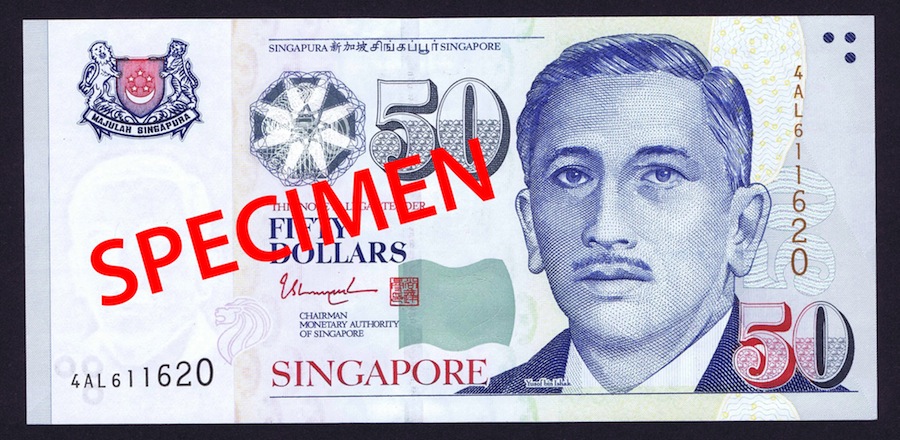
Singapore’s $50 banknote now carries the one triangle symbol on the reverse (below the word Arts). The signature on the new paper money has also been updated to that of Deputy Prime Minister Tharman Shanmugaratnam. This is the first denomination of banknotes to reflect his appointment as the new Chairman of the Monetary Authority of Singapore.
The first prefix for this variety is 4AA. Currently, other prefixes including 4AC, 4AD, 4AE, 4AF, 4AG, 4AJ, 4AL and 4AQ, 4AT and 4AU have been observed in circulation.
Update (12 July): Prefixes 4AH, 4AM, 4AR were spotted.
The MAS $50 banknote has three different signatures to date, including that of Prime Minister Lee Hsien Loong (released in August 2004, 2AA) and Emeritus Senior Minister Goh Chok Tong (released in November 2009, 3AA). Both used to hold the position of Chairman MAS. Before the MAS issue, the Board of Commissioners of Currency Singapore (BCCS) has issued banknotes signed by Richard Hu (released in September 1999, 0AA; reprinted in 2011, 1AA to 1HF and 1JJ) and Lee Hsien Loong (released in 2002, 1HL to 1HZ and 1KA to 1KN).
MAS started issuing banknotes with symbols printed on the reverse since 2008 as an added security feature for their internal authentication. It has been understood that these symbols are used to indicate the print batch number for that particular denomination, and two of the future symbols will include the circle and star.
It is observed that two denominations printed during the same period may not have the same symbol. For example, the one triangle symbol is used on the $50 note (printed some time between 21 May 2011 and early July 2012) while the $10 banknote with one triangle was released in November 2010. The $2 note with one triangle was first spotted in circulation in February 2011.
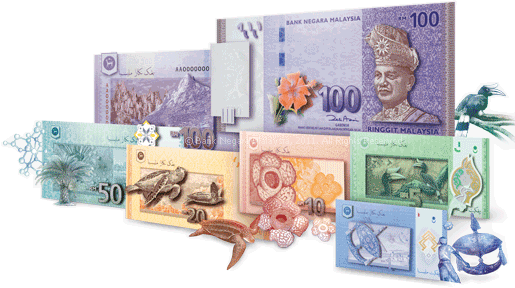
Bank Negara Malaysia has announced that the new Malaysian banknotes series will be introduced into circulation from 16 July 2012, replacing the current series that has been in circulation for over ten years. Themed ‘Distinctively Malaysia’, the banknotes feature intricate illustrations of the nation’s culture and traditions. In this series, the RM 2 banknote was no longer issued, while a new RM 20 banknote was included in the line-up.
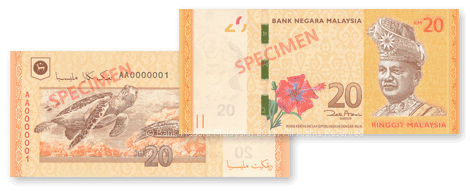
The fourth series of Malaysian banknotes consists of six denominations, including RM 1 (Traditional Pastimes: Wau Bulan), RM 5 (Wildlife: Rhinoceros Hornbill), RM 10 (Flora: Rafflesia Azlanii), RM 20 (Marine Life: Hawksbill, Leatherback Turtle), RM 50 (Agriculture and Technology: Oil Palm, Biotechnology) and RM 100 (Natural Wonders: Mount Kinabalu, Gunung Api Valley).
The obverses of the banknotes retain the portrait of the first Seri Paduka Baginda Yang di-Pertuan Agong, Tuanku Abdul Rahman ibni Tuanku Muhammad. In addition, other common motifs on the banknotes include Malaysia’s national flower (Rosa-sinensis hibiscus) and patterns of traditional songket weaving in the background.
The smaller denominations of banknotes (RM 1, RM 5) are more commonly used in day-to-day transactions and printed on polymer to increase their level of durability. The larger denominations remain printed on paper.
Incorporating modern printing technology and security features, the fourth series of Malaysian banknotes contains a pixel watermark portrait with highlight numeral, as well as the use of micro lens thread and iridescent patch. Existing security features which are retained in the fourth series include perfect registration, multicolour latent image, intaglio printing, microprinting, colour shifting security thread, holographic stripes and UV elements.
Bank Negara Malaysia has also released a commemorative folder containing the fourth series of Malaysian banknotes on 22 December 2011. The complete set, limited to 50,000 sets and priced at RM 300, consists of six banknotes of the same serial number. Currently, low serial numbers – AA0001500 and below – have not been observed, except for AA0000001 which is used throughout BNM’s website. Two smaller folders, one containing the RM 20 banknote (sold for RM 30) and another containing the RM 1 and RM 5 banknotes (sold for RM 15) were also available, with a more generous supply of 500,000 sets.
If you have been to Malaysia in the past few years, you would have already noticed the new RM 50 note in circulation. This banknote was first introduced in December 2007 to commemorate Malaysia’s 50th Anniversary of Independence. The first 50 million pieces (AA0000001 to AE9999999) of the note is overprinted with the logo of the 50th Anniversary of Independence on the reverse, including 20,000 sets sold in a limited edition folder. A number of these overprinted notes continue to exist in circulation alongside those which does not contain the overprint (AF0000001 onwards). The new RM 50 banknotes released in December 2011 have 3-letter prefixes (AAA0000001 to AAA0050000).